Ci in Italian: how to use ci and ne
What are ci and ne
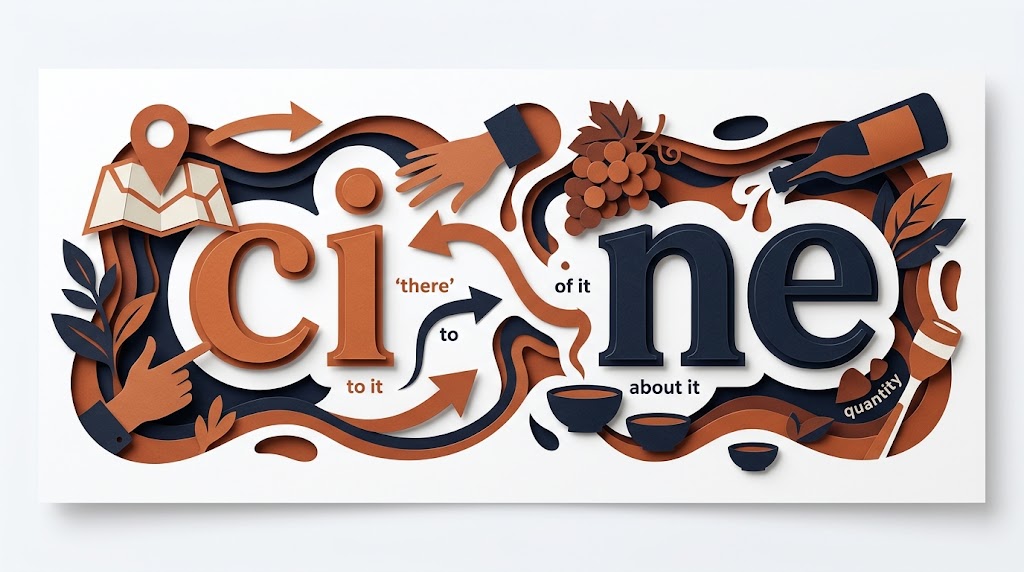
Ci and ne replace a noun together with the preposition that comes before it, and the preposition hides inside the little word. There is no single English word you can memorize for either of them. What each of them has instead is a set of uses.
Look at this table as a reminder of which word to use when it replaces a preposition plus a noun, and refer to the rest of the article for many examples and for the other uses that go beyond the replacements listed in the table:
| Pronoun | Replaces | Approximation in English |
|---|---|---|
| ci | in quel posto | in that place |
| ci | a questa cosa | to/about this thing |
| ci | con questa cosa/persona | with this thing/person |
| ci | su questa cosa/persona | on this thing/person |
| ne | di questa cosa | of this thing |
| ne | da quel posto/cosa | from that place/thing |
Uses of ci
1. ci = in quel posto (going there, going to that place)
The word ci can replace a place that has just been mentioned, with a verb that indicates moving to that place. For example:
Roma è bella. Ci vado spesso. (Rome is beautiful. I go there often)
Non sono andato in ufficio per una settimana. Ci vado domani. (I haven’t been to the office for a week. I’m going there tomorrow)
2. ci = in quel posto (staying in that place)
The word ci can also replace the noun of a place in connection with a verb that indicates permanence in that place. For example:
Andrò in vacanza in Salento e ci rimarrò due settimane. (I’ll go on vacation in Salento and stay there for two weeks)
You have probably already met c’è and ci sono: these are examples of ci meaning in this place or in that place:
Ci sono due ristoranti qui. (There are two restaurants here = in this place)
3. ci = a questa / quella cosa (verbs followed by a)
Some verbs are followed by a, such as:
- pensare a qualcosa (to think about something)
- abituarsi a qualcosa (to get used to something)
- credere a qualcosa (to believe something)
So, for example:
Il lavoro che ho mi piace molto. Ci penso spesso. (I like my job. I often think about it, because the base sentence is penso spesso al mio lavoro)
La nuova città è molto diversa. Non mi ci abituo. (The new city is very different. I can’t get used to it, because the base sentence is mi abituo alla città)
Non ci credo! (I can’t believe it, because the base sentence is credo a questa cosa)
4. ci = a fare questa cosa (replacing an action)
Look at this example with riuscirci:
Ha provato tante volte e alla fine ci è riuscito. (He tried many times and in the end he succeeded at doing it)
If I said Lui è riuscito, the sentence would be incomplete: è riuscito… a fare cosa? (He succeeded… at doing what?). So I have to complete the sentence, either by specifying what he did or by replacing the action with ci.
-
È riuscito a laurearsi. (He managed to graduate) This sentence explains explicitly: riuscire + a + verb.
-
Voleva finire l’università e ci è riuscito. (He wanted to finish university, and he succeeded) Here the second part of the sentence replaces the action with ci. If we didn’t use ci, we would have a repetition: Voleva finire l’università ed è riuscito a finire l’università.
Provarci belongs to the same category:
Ho deciso di provarci. = provare a fare quella cosa (I decided to try, that is, to try to do that thing)
5. ci = con questa/quella cosa/persona (with something or someone)
Ci can also replace con + something:
Adoro il mio cane. Ci gioco sempre. = Gioco sempre con il cane (I love my dog. I always play with him. = I always play with the dog)
6. ci = su questa/quella cosa/persona (on something or someone)
Ci can replace su + something:
Marco è affidabile. Ci puoi fare affidamento. = Puoi fare affidamento su Marco (Marco is reliable. You can rely on him. = You can rely on Marco)
Su di me ci puoi contare. = Puoi contare su di me (You can count on me)
7. ci riflessivo (reflexive)
Ci appears in the list of pronomi riflessivi, diretti e indiretti corresponding to the person of noi (we). When it is used like this, ci can mean “ourselves”, “us” or “to us”. You can find an article especially dedicated to this topic here: Italian pronouns.
Here are some quick examples; for the extended explanation, please refer to the detailed article linked above.
Noi ci laviamo. (We wash ourselves)
8. ci pronome diretto (direct object)
Tu ci hai visti al parco ieri? = hai visto noi (Did you see us at the park yesterday? = you saw us)
9. ci pronome indiretto (indirect object)
Tu ci hai dato un regalo bellissimo. = hai dato un regalo a noi (You gave us a beautiful gift = you gave a gift to us)
10. ci nei verbi pronominali (pronominal verbs)
The addition of particles to common verbs modifies their meaning, creating pronominal verbs. For example, volere means “to want”, but volerci indicates how long it takes to do something, or what is needed to do something.
Da Milano a Roma ci vogliono 3 ore in treno. (It takes 3 hours to get from Milan to Rome by train)
Ci vuole pazienza! (It takes patience!)
Uses of ne
1. ne = una parte / riferito a una quantità (a part / related to a quantity)
Ne can be used in combination with a number, to replace a noun I don’t want to repeat:
Le arance erano succose e ne ho comprate dieci. (The oranges were juicy, and I bought ten of them)
or an undetermined amount:
Mi serviva dell’olio e ne ho preso un po’. (I needed some oil, so I took some)
La notte di San Lorenzo è famosa per le stelle cadenti; l’anno scorso ne ho viste tante. (The night of San Lorenzo is famous for shooting stars; last year I saw many of them)
2. ne = di questa/quella cosa (talking about a topic or a concept)
Adesso non c’è tempo; ne parliamo domani. (There is no time right now; let’s talk about it tomorrow, because the base sentence is domani parliamo di questa cosa)
Che ne pensi? (What do you think about it?)
- Ti serve un ombrello? - No, non ne ho bisogno. (- Do you need an umbrella? - No, I don’t need it)
3. ne = da questo/quel posto/cosa (leaving a place)
Ne can be used when replacing da + noun, like in uscire + da + un posto (leaving a place):
Giovanni è entrato nella stanza e non ne è ancora uscito. (Giovanni entered the room and has not come out yet, because the base sentence is non è più uscito da quel posto)
Check this example where we find separarsi + da + un oggetto (to separate from something):
Quando Martina era piccola amava la sua bambola: non se ne voleva mai separare. (When Martina was little, she loved her doll; she never wanted to part with it, because the base sentence is lei si separa da un oggetto)
4. ne nei verbi pronominali (pronominal verbs)
As we said for ci, ne has also been added to some verbs to change their meaning.
So, for example, andare means “to go”, but andarsene means “to leave”:
Basta! Me ne vado! (Enough is enough! I’m leaving!)
Potere means “to be able to”, but non poterne più means “to be exhausted or sick of something”:
Non ne posso più di questa situazione! (I can’t take this situation anymore!)
Remember: in pronominal verbs, it is not the speaker who decides to add some particles to the verb to change its meaning. The pronominal verbs already exist and we have to use them as they are. It is not a matter of choice to use the pronominal version or the base form: both exist and have different meanings.
How to choose: the verb decides
Never use English to find out which one to use in Italian. The choice between ci and ne must rely on Italian prepositions, and English prepositions often don’t match the Italian ones.
Let’s imagine we have a sentence to complete, and we have to figure out which pronoun to use:
La biblioteca è un luogo silenzioso: ___ vado spesso per lavorare
The first step is to imagine the sentence in its base form:
Io vado in biblioteca per lavorare
Then to identify which is the chunk that we want to replace:
in biblioteca = in quel posto
and which is the preposition that it contains:
in
Since in is related to ci, we use ci:
La biblioteca è un luogo silenzioso: ci vado spesso per lavorare.
Let’s look at another example:
- Secondo te il Milan vincerà lo scudetto? - ___ dubito.
Dubitare means “to doubt”. When the verb is new to you and you are not sure which preposition it wants, look it up. I send my students to Internazionale’s dictionary because the examples are short and useful: the entry for dubitare shows this example, “ho sempre dubitato della sua lealtà; ho sempre dubitato di lui”. This means that the right combination is dubitare + di + qualcosa.
In our example, the base form is:
Io dubito della vittoria del Milan
Since di is related to ne, the right replacement is:
- Ne dubito.
ci and ne with another pronoun
When ci or ne meets another pronoun, the two join into one word and the first one changes shape: ci becomes ce, mi becomes me, ti becomes te, vi becomes ve, and gli and le become glie-.
Ce ne sono tre. (There are three of them)
Me ne ricordo bene. (I remember it well)
Ve ne parlo domani. (I will tell you about it tomorrow)
Gliene ho dati due. (I gave him two of them)
The full grid of combinations is in Italian pronouns: every type, explained with charts, if you want to see where ce ne and me ne come from.
Verbs that come with ci or ne
These are the ones that come up in conversation most, with the preposition that decides the pronoun.
| Verb and preposition | With the pronoun | English |
|---|---|---|
| andare a | ci vado | I am going there |
| pensare a | ci penso | I am thinking about it |
| credere a | ci credo | I believe it |
| provare a | ci provo | I give it a try |
| riuscire a | ci riesco | I manage it |
| parlare di | ne parlo | I talk about it |
| avere bisogno di | ne ho bisogno | I need it |
| ricordarsi di | me ne ricordo | I remember it |
| dubitare di | ne dubito | I doubt it |
| approfittare di | ne approfitto | I take advantage of it |
The mistakes my students actually make
- Choosing by English feeling. “I believe it” and “I talk about it” look identical in English and take ci and ne in Italian. Ask the verb, not the translation.
- Leaving ne out with a quantity. The answer to Quanti fratelli hai? is Ne ho due. (I have two), not ho due.
- Forgetting the participle agreement. Ne ho preso una should be Ne ho presa una.
How to practice ci and ne
Take a sentence about your own day and change one noun into one of these two words.
Penso alla mia prossima vacanza. (I am thinking about my next holiday) becomes Ci penso ogni giorno. (I think about it every day)
Ho bisogno di più tempo. (I need more time) becomes Ne ho bisogno subito. (I need it right away)
Say the pairs out loud, the long version and the short one, and say them again a week later. The first ten times you will check the preposition in your head. After that the choice arrives with the verb, which is what fluency feels like from the inside.
Want a Hand?
You now know what ci and ne stand for, and the two questions behind most of the confusion are answered. The part that takes a teacher is using them while you speak, when nobody has time to run through a chart. That is what we do in a lesson: you talk about your week, and I catch the missing ne while the sentence is still open.
Book a free trial lesson and we will practice with sentences about your own life.