Italian movies, from easiest to hardest: 8 films to start with
Italian movies, from easiest to hardest: 8 films to start with
Learning Italian is mostly a question of hours. The more Italian you take in, the more you understand. With time, Italian stops sounding like noise and you start to recognize words and to understand what the characters are saying.
Lessons give you the rules, but language skills come from the number of hours you spend using the language, either by listening or by listening and talking, as in a dialogue. So, since you need to spend many hours in contact with the language in order to improve, what is a way that doesn’t feel like a workload and is pleasurable instead? I’ve found my answer, and my answer is “watching movies”.
Two hours with an Italian film put you in touch with real voices and the rhythm of the language as it is actually spoken. Vocabulary goes in without you noticing, your pronunciation improves from hearing it done well, and you get a story out of it. That is a good return for one evening on the sofa. You also learn about the history and culture of a country, and when I say “culture” I mean how people think, what their values are, how they react emotionally to events, the background the story is set in, how people behave in a different country, and much more.
Here are eight films I suggest, ordered from the easiest to follow to the hardest. Next to each title I’ve put the approximate CEFR level. If you’re not familiar with CEFR levels, as a rule of thumb you should remember that A1 and A2 mean “beginner”, B1 and B2 mean “intermediate”, and C1 and C2 mean “advanced”.
Here is the whole list at a glance.
| # | Film (English title, year) | Level |
|---|---|---|
| 1 | Nuovo Cinema Paradiso (Cinema Paradiso, 1988) | B1 - B2 |
| 2 | Pane e tulipani (Bread and Tulips, 2000) | B1 - B2 |
| 3 | Perfetti sconosciuti (Perfect Strangers, 2016) | B1 - B2 |
| 4 | Malena (2000) | B2 |
| 5 | Il postino (The Postman, 1994) | B2 - C1 |
| 6 | La pazza gioia (2016) | B2 - C1 |
| 7 | La dolce vita (1960) | B2 - C1 |
| 8 | La grande bellezza (The Great Beauty, 2013) | C1 - C2 |
1. Nuovo Cinema Paradiso (Cinema Paradiso) (1988)
Nostalgic, Heartfelt, Drama. Directed by Giuseppe Tornatore.
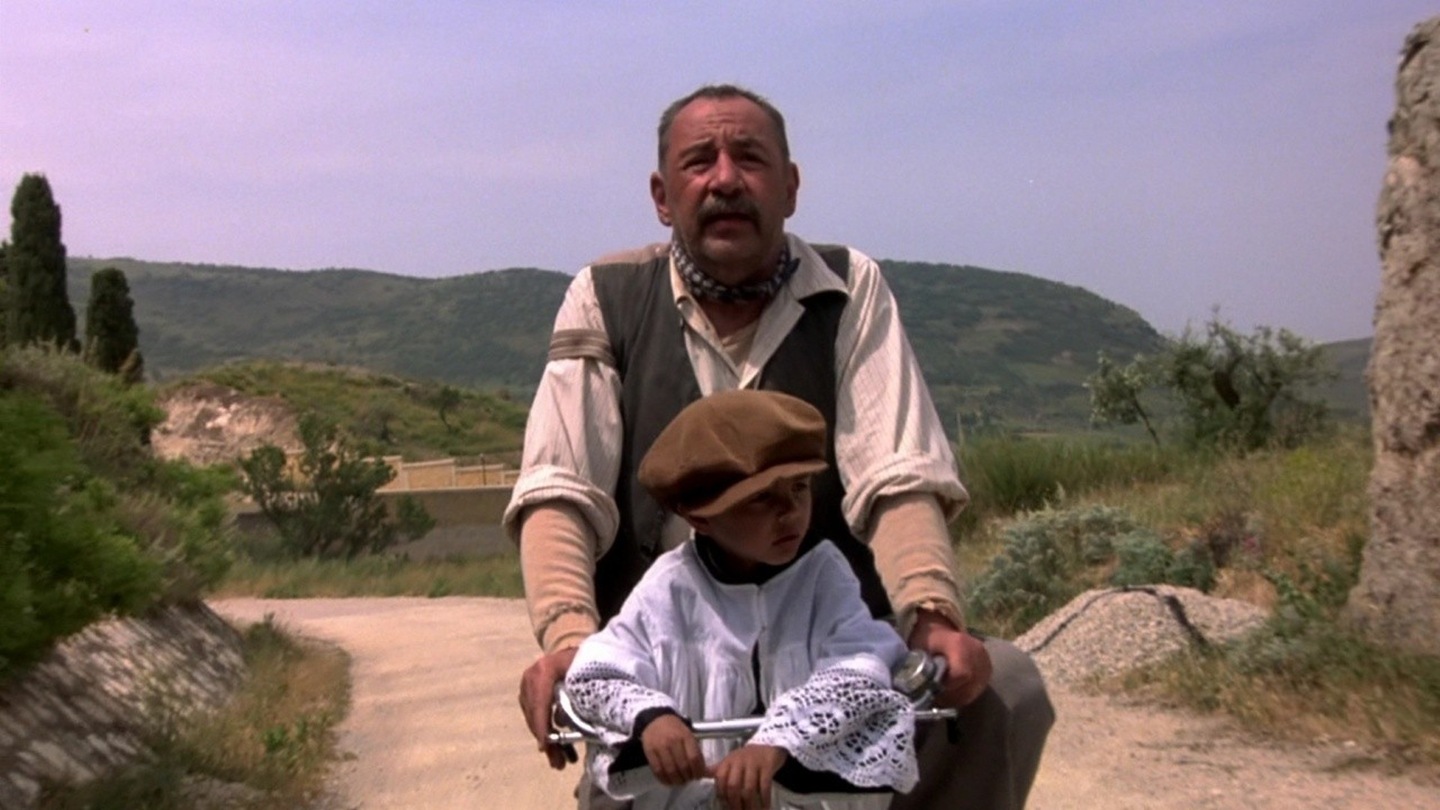
A famous film director in Rome hears that an old man has died in the Sicilian village where he grew up, and the news takes him back decades. As a boy, Salvatore spent every free hour in the village cinema, and the projectionist Alfredo became the father he did not have there. The film follows that friendship and the village that revolved around the parish cinema. It won the Academy Award for Best Foreign Language Film, and it made Tornatore’s name internationally. Long stretches pass with hardly any dialogue, so when the words stop, the story keeps going.
Level: B1 to B2.
2. Pane e tulipani (Bread and Tulips) (2000)
Whimsical, Feel-Good, Romance. Directed by Silvio Soldini.
Rosalba is on a coach tour with her husband and her sons when the bus leaves a motorway stop without her. Instead of chasing it, she accepts a lift and ends up in Venice, where she finds a room, a job in a flower shop and, for the first time in years, days that belong to her. She meets a waiter from Iceland who is as displaced as she is. Soldini fills the film with small, specific people, and the whole film runs on conversation: the sentences are short and the vocabulary is everyday, which is good news for a learner.
Level: B1 to B2.
3. Perfetti sconosciuti (Perfect Strangers) (2016)
Witty, Tense, Drama. Directed by Paolo Genovese.
Seven old friends, three couples and one man on his own, meet for dinner at a flat in Rome. Someone suggests a game: every phone goes face up on the table, and every message and call gets read out loud. What starts as a joke carries on through the evening. It is a comedy about ordinary adult life, and almost all of it happens around one table. That is exactly why it belongs on this list, because it gives you two hours of the Italian people speak at dinner, at speed, interrupting each other. The film has been remade in many countries, and the Italian original is still the sharpest.
Level: B1 to B2.
4. Malena (2000)
Melancholic, Sensual, Coming-of-Age. Directed by Giuseppe Tornatore.
A small Sicilian town during the Second World War, seen through the eyes of Renato, a boy on the edge of adolescence. Malena is the young widow every man in town watches and every woman in town talks about, and Renato is entirely, hopelessly fascinated. The story belongs to the town as much as to the boy: the gossip, the envy, and the pressure of being watched by everyone. Tornatore tells it with very little dialogue and a great deal of sunlight. For a learner that is a gift, because the film makes sense before you understand a word of it.
Level: B2.
5. Il postino (The Postman) (1994)
Gentle, Heartwarming, Romance. Directed by Michael Radford.
Pablo Neruda, the Chilean poet, arrives on a small Italian island in political exile. Mario, a local fisherman’s son who has never read a poem in his life, takes the job of carrying the poet’s post because he wants a reason to talk to the woman he likes. The friendship that grows between the two men becomes the whole film. It moves slowly, in simple sentences, and it works even when you miss a word, because so much of it happens in faces and landscape. One of the gentlest watches in Italian cinema, and one of the most warmly received Italian films of the nineties.
Level: B2 to C1.
6. La pazza gioia (2016)
Quirky, Tender, Dramedy. Directed by Paolo Virzì.
Beatrice talks to everyone and trusts nobody. Donatella hardly speaks at all. They meet in a residential clinic in the Tuscan countryside, and when an outing goes wrong the two of them end up on the road together, with Beatrice’s money, Donatella’s one fixed idea about where she needs to be, and no plan at all. Virzì made it as a road movie about two women the people around them had quietly written off. The Italian runs fast and idiomatic, with Tuscan accents all through it, so the grammar is not the difficulty here, the speed is.
Level: B2 to C1.
7. La dolce vita (1960)
Hedonistic, Existential, Drama. Directed by Federico Fellini.
Marcello is a gossip journalist who writes about film stars and rich people for a living. He wants to write a novel, he has wanted it for a while, and instead he goes to parties, follows stories and drifts through nightly Rome. Fellini built the film out of episodes, so you can watch it as a run of evenings rather than one plot, and the images are among the most famous in cinema, from the fountain to the helicopter carrying a statue over the city. It is long, close to three hours. This is the film that explains why Italian cinema gets talked about as an art form.
Level: B2 to C1.
8. La grande bellezza (The Great Beauty) (2013)
Opulent, Satirical, Drama. Directed by Paolo Sorrentino.
Jep Gambardella published one novel when he was young and has spent the decades since moving through Rome’s parties, terraces and dinner tables. He knows everyone there, controls nothing, and watches it all with an eye that never quite stops writing. The film drifts between those evenings rather than pushing a plot, and Sorrentino’s Rome looks like nothing else in cinema. It is also the hardest Italian on this list by some distance, which is why it sits at the end of the ladder.
Level: C1 to C2.
How to watch movies in a foreign language
Here are two essential things to keep in mind when you approach a movie in a foreign language for learning purposes.
Here’s the first suggestion. At the beginning, it’s better to watch the movie with Italian audio and English subtitles. Then, when you feel comfortable, you can switch to Italian subtitles. You can keep using Italian subtitles while you learn, even at an advanced level: don’t feel bad if you can’t switch them off. Sometimes movies can be harder to understand than people in real life, mostly because people make an effort to be understood, while movies are made for native speakers.
And then my second suggestion, the most important: keep it pleasurable! So don’t stress too much if you don’t understand every word. You just need to understand roughly what is going on, and your brain picks up and stores new words even when you are not consciously aware of it. Keep watching and the gaps fill in on their own.
Choose movies you actually like, not the ones you think you “should” watch. If after a few minutes you realize you don’t like the film, or the language is too hard to follow and it frustrates you, switch to another title. Learning a language is a marathon, not a sprint, so take it easy and make it sustainable over time. Just relax and enjoy.
If series suit your evenings better than films, we picked fifteen to begin with in Italian TV shows: 15 series to learn Italian from.
Want a Hand?
Watching is how the hours go in, and it is the part you can do alone. Speaking needs another person, and that is where a teacher earns their keep. Someone who corrects your pronunciation before it settles into a habit, answers the questions a film leaves behind, and turns an evening you enjoyed into a conversation you can hold.
Pick one film from this list, watch it this week, then bring it to a lesson. Tell us what you loved and what you lost along the way.
Book a free trial lesson, or meet our teachers and see who fits the way you want to learn.