Italian TV shows: 15 series to learn Italian from
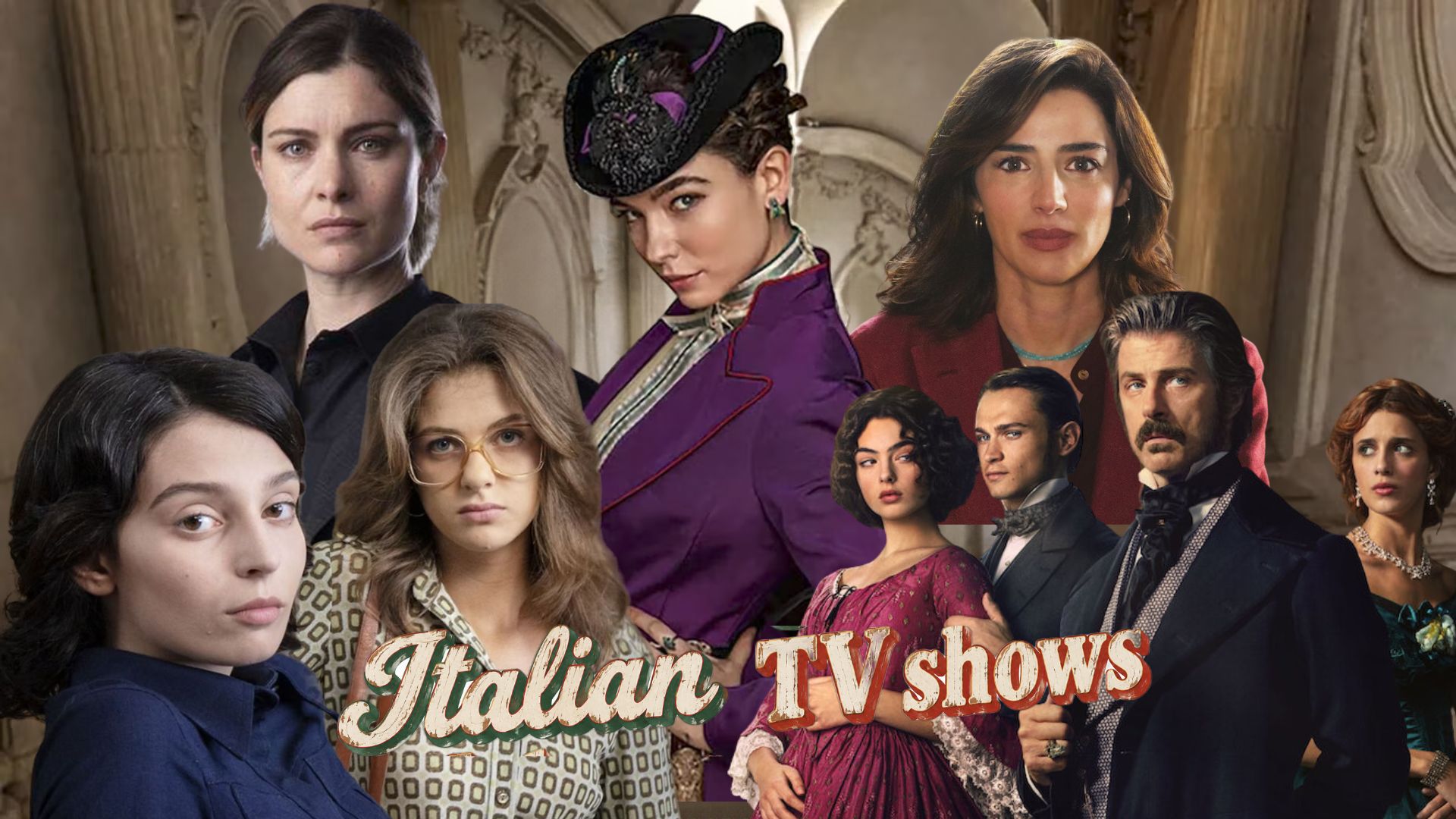
Italian TV shows: 15 series to learn Italian from
Search for “Italian shows to watch” and you land in an endless list with no idea where to start. In this article I want to share something different with you: the 5 Italian series my students are watching in 2026.
I indicate the CEFR level of each show, that it, the complexity of the language. If CEFR means nothing to you yet, the rule of thumb is that A1 and A2 are beginner, B1 and B2 are intermediate, and C1 and C2 are advanced. Treat the level as a starting point. Nobody certifies a TV series, and the same show can be easier or harder depending on the episode.
1. Che Dio ci aiuti (May God Help Us) (2011)
Big-hearted, Chatty, Comedy drama. Created by Carlotta Ercolino.
Suor Angela is a nun with an unusual past: she spent time in prison before she changed her life completely. She lives in the Convento degli Angeli in Modena, which is about to close for lack of vocations and a pile of unpaid bills. Her solution is to turn the convent into a boarding house, with a bar inside called l’Angolo Divino, and to fill it with people who have nowhere better to go.
Three young women move in first, Giulia, Azzurra and Margherita, with characters and problems that have nothing in common. Watching over all of them is suor Costanza, the wise and permanently irritated mother superior, who scolds Angela for every rule she bends and loves her like a daughter. Later seasons bring new residents, two law students among them, and Guido Corsi, a university professor who becomes the house tutor. Filming moved between Modena, Fabriano and Assisi.
Level: A2 to B1. Clear standard Italian, no strong accent.
2. Odio il Natale (I Hate Christmas) (2022)
Light, Festive, Romantic comedy. Created by Per-Olav Sørensen, from the Norwegian series Natale con uno sconosciuto.
Gianna is thirty, a nurse, happy at work and stuck everywhere else. Her ex Francesco left her three years ago and she has not had a relationship since, a fact her family raises at every meal. Tired of it, she tells them a small and enormous lie: she has a boyfriend, and she will bring him to Christmas dinner. That gives her twenty-four days.
What follows is a run of bad decisions. Mario, a fishmonger with a strong attachment to his mother. Carlo, a wealthy businessman in a wheelchair after a motorway crash. And Davide, nineteen and still in school, found after her friend Titti signs her up to Tinder without asking. Twenty-four days is not much time, and the closer the twenty-fourth gets, the heavier the lie becomes. Set in Chioggia, on the lagoon south of Venice, over two seasons.
Level: B1. Neutral modern Italian at a normal conversational pace.
3. Summertime (2020)
Sunny, Youthful, Teen drama. Directed by Lorenzo Sportiello and Francesco Lagi.
Summer and Alessandro want opposite things from the same season. She is introverted, hates the heat, and spends the summer working rather than resting after a year of school. Her parents are artists, her mother a singer, and their work keeps taking them away from home. She has two close friends, Sofia and Edoardo, and when Sofia notices Summer drifting towards Alessandro she switches her loyalty to Dario, Alessandro’s best friend and fellow engine obsessive.
Alessandro is Roman, a professional motorcycle racer, permanently at war with his father, whom he leaves behind to chase his career in Spain with a rival team. His mother Laura runs the hotel on the Romagna riviera where much of the summer happens. He falls for Summer, and the two of them get a summer on the riviera that neither of them is quite equipped for.
Level: B1 to B2. Contemporary Italian, clear delivery, some youth slang.
4. Camera Café (2003)
Deadpan, Absurd, Office sitcom. Directed by Christophe Sanchez, from the French format Caméra Café.
The camera does not move. It sits in front of the coffee machine in an office break area, and the whole series happens in the few metres in front of it, as the staff of an unnamed Italian company pass by, argue, gossip and scheme. Every one of them is a caricature of a line on the org chart, and none of them is flattered by it.
The two who carry the show are Paolo Bitta, head of sales, an alcoholic and a relentless womanizer, and Luca Nervi, head of purchasing and union representative, greedy and thoroughly corrupt. Around them: Silvano Rogi, the naive accountant who gets everything wrong; Patrizia “Patti” D’Imporzano, the secretary; Alex Costa, the uninhibited administrative secretary and Luca’s girlfriend; and Augusto De Marinis, the tyrannical director. From the fourth season the company is swallowed by its upstairs rival Digitex, and things get worse from there. It ran for 1,769 episodes between 2003 and 2018.
Level: B1 to B2. Office Italian at natural speed, in very short episodes.
5. Un medico in famiglia (A Doctor in the Family) (1998)
Warm, Domestic, Family comedy. Created by Carlo Bixio.
Gabriele “Lele” Martini is a doctor and a widower with three children. At the start of the series he moves the whole family, his father Libero included, into a house shared with relatives, and the next ten seasons are what happens to that arrangement. Giulio Scarpati plays Lele, Lino Banfi plays Nonno Libero, and the grandfather became the show’s signature. Claudia Pandolfi plays Alice Solari, Lunetta Savino plays Cettina, and Milena Vukotic plays Enrica.
The medical cases arrive through the front door, the children grow up, and every argument finds its way to the dinner table, which is where most of the important conversations in the series happen. It ran on Rai 1 from 1998 to 2016, 148 episodes across ten seasons, and it is still the reference point for what an Italian family drama looks like.
Level: A1 to A2. Short, clear dialogue and everyday family vocabulary.
6. Sicilia Express (Sicily Express) (2025)
Silly, Festive, Comedy. Directed by Ficarra e Picone.
Salvo and Valentino are two Sicilian nurses working in a clinic in Milan, commuting between the two halves of their life on low-cost flights: Milan, where the work is, and Sicily, where their families are. Their medical director, an authoritarian Calabrian who pretends to be Milanese, refuses to grant them leave, which blocks their trips home and makes the tension with their families worse every week.
Then, one night, Valentino’s daughter makes a Christmas wish about spending more time with her father, and the two of them find a rubbish bin that teleports them from Piazza del Duomo in Milan to a street in their own village, and back again. Five episodes, released in December 2025, and the shortest thing on this list.
Level: B1 to B2. Sicilian accent, short sentences, visual comedy.
7. Incastrati (Framed! A Sicilian Murder Mystery) (2022)
Witty, Tense, Comedy thriller. Directed by Ficarra e Picone.
Valentino and Salvo are two unlucky television technicians who stumble onto the scene of a murder. Rather than call anyone, they use everything they have learned from police series to clean the place and walk away, which is the first of a long series of decisions that make things worse.
The plan collapses almost immediately. A pair of Jehovah’s Witnesses turn up at the worst possible moment and mistake Valentino for the owner of the house, which is only the first of the complications. Before long the two of them are being watched from three directions at once: by the local police, by a woman named Agata whom Valentino knew at school and who now runs the local station, and by people considerably more dangerous than either of them. Every attempt to talk their way out of the situation creates a new one, and they spend two seasons trying to stay a step ahead of all of it.
Level: B1 to B2. Sicilian setting, short sentences, repeating situations.
8. SKAM Italia (2018)
Raw, Contemporary, Teen drama. Created by Ludovico Bessegato.
A group of friends at the J. F. Kennedy high school in Rome, followed from the third year of school to the start of university. The structure is the show’s idea: every season hands the lead role to a different member of the group, so the same events come back from a new angle each time, and the story arrives through texts, chats and social posts as much as through scenes.
The first five seasons cover the original group. A second group, two years younger, appears in the fifth, and in the sixth they take over completely while the older characters drop in only for cameos. Elia is the one constant, the only character who belongs to both groups and stays through the whole run. Six seasons between 2018 and 2024.
Level: B2. Fast Roman speech and current youth slang.
9. Le indagini di Lolita Lobosco (Lolita Lobosco) (2021)
Charming, Breezy, Crime comedy. Created by Luca Miniero, from the novels by Gabriella Genisi.
Lolita Lobosco comes back to Bari, the city she left years earlier, to take charge of a squad made up entirely of men, most of whom would rather she had stayed in the north. She refuses to play the part they have in mind for her: she does not flatten her personality or her appearance to fit in, and instead uses both to get what she needs from a world that is still run by men.
Around the cases there is her family, her friends and a journalist who keeps turning up at the worst possible moment. The character comes from a series of crime novels by Gabriella Genisi, and Rai 1 has been running the adaptations since February 2021. Luisa Ranieri plays the lead, and Bari gets the kind of screen time Italian series usually reserve for Rome and Milan: the sea, the old town, the food.
Level: B2 to C1. A light southern accent over standard Italian.
10. Il processo (The Trial) (2019)
Cold, Precise, Legal drama. Directed by Stefano Lodovichi.
Elena Guerra is a public prosecutor with a good record and a plan: a sabbatical year in New York, where her husband has been transferred. The plan dies when she is handed a case she cannot pass on. The victim is Angelica Petroni, seventeen, killed with a brutality that makes the file hard to read, and the trial ahead of her is not going to be simple.
Opposite her is Ruggero Barone, a famous criminal defence lawyer hired by a very wealthy client, Linda Monaco, who is accused of the killing. Eight episodes of interviews, evidence and pressure, and Vittoria Puccini plays a prosecutor who is excellent at her job and considerably worse at her own life.
Level: B2 to C1. Legal and procedural Italian in a formal register.
11. La legge di Lidia Poët (The Law According to Lidia Poët) (2023)
Elegant, Determined, Period crime. Created by Guido Iuculano and Davide Orsini, directed by Matteo Rovere.
Turin, 9 November 1883. A ruling from the Court of Appeal declares Lidia Poët’s registration to the bar illegitimate, and the only reason given is that she is a woman. She has no money and no shortage of pride, so she takes a job at her brother Enrico’s law firm and starts preparing the appeal that will overturn the decision.
The wait lasts thirty-five years. In the meantime she works alongside Enrico on the cases nobody else wants, above all the rights of minors, the marginalized and women, and the series builds its murders and investigations around that work. In 1920 the law finally changes and Lidia, sixty-five years old, joins the bar as the first woman ever admitted to it. Matilda De Angelis plays her, and the series won a Nastro d’argento for best crime series.
Level: B2 to C1. Formal, historical Italian with clear enunciation.
12. Boris (2007)
Savage, Insider, Satire. Created by Luca Manzi and Carlo Mazzotta.
Alessandro wants to work in show business, and he gets his chance as an intern on the set of Gli occhi del cuore 2, a television drama. Within a day he understands that the world he has been dreaming about looks nothing like this, and that the people running it are, without exception, strange.
René Ferretti is the director, a man who gave up his artistic ambitions years ago and now carries a goldfish named Boris to work while describing his own product with contempt. Stanis is the lead actor, mediocre and convinced he is a Hollywood star. Corinna is the female lead, whom René addresses as “cagna maledetta” because she cannot act at all. Arianna, the assistant director, is the only person on set trying to solve problems instead of creating them. Around them: Biascica the electrician, Duccio the cinematographer, Itala the script supervisor, and Lorenzo, the other intern. Four seasons between 2007 and 2022.
Level: B2 to C1. Overlapping dialogue at speed, in TV jargon.
13. Il Gattopardo (The Leopard) (2025)
Sumptuous, Melancholy, Historical drama. Directed by Tom Shankland, from the novel by Giuseppe Tomasi di Lampedusa.
Sicily, 1860. Garibaldi’s Expedition of the Thousand lands on the island and the population welcomes it, which means the Bourbon kingdom is finished. Fabrizio Corbera, Prince of Salina, is not sentimental about the old order and not naive about the new one. He moves his family out of the city to safety while his nephew Tancredi joins the men making trouble for the incoming government, gets arrested for it, and is freed thanks to his uncle’s name.
What follows is a family negotiating its own survival, and the series gives as much room to the young as to the old. Angelica, the daughter of a rich man with no aristocratic blood, arrives in their world with ambitions of her own. The Prince travels to Turin and is offered a role in the future of Italy, and turns the offer over in his hands. Around all of it, his daughter Concetta watches the life she had expected rearrange itself. Six episodes, and the second adaptation after Visconti’s film of 1963.
Level: C1 to C2. Period Italian with Sicilian and French in it.
14. Il Commissario Montalbano (Inspector Montalbano) (1999)
Sunlit, Patient, Police procedural. Directed by Alberto Sironi, from the novels by Andrea Camilleri.
Salvo Montalbano is the police commissioner of Vigàta, a fictional Sicilian town. He is gruff, thorough and permanently hungry, serious about the work and unexpectedly gentle with the people he trusts, and he solves the crimes of his corner of Sicily by noticing what everyone else has walked past.
The station around him is a cast of fixed characters: Domenico “Mimì” Augello, the deputy commissioner and an unrepentant womanizer; Giuseppe Fazio, the chief inspector, serious and dutiful; Galluzzo, the reckless one; and Agatino Catarella, who answers the phone, misunderstands everything and opens doors with his face. Outside it, his Swedish friend Ingrid Sjöström, the journalist Nicolò Zito and Pasquale, the wayward son of his cook. In his private life he carries on a long-distance relationship with Livia Burlando, from Genoa, stormy and enduring. Thirty-six feature-length episodes between 1999 and 2021.
Level: C1 to C2. Standard Italian against Sicilian dialect.
15. L’amica geniale (My Brilliant Friend) (2018)
Intense, Beautiful, Literary drama. Created by Saverio Costanzo, from the novels by Elena Ferrante.
Elena “Lenù” Greco and Raffaella “Lila” Cerullo grow up in a poor neighbourhood on the edge of Naples, and the series follows the two of them across sixty years. Their friendship is the whole subject: competitive, tender, sometimes cruel, and never equal for long, with the two of them swapping places as the one who gets out and the one who stays.
It adapts the entire four-novel sequence by Elena Ferrante, one season per book, from childhood through marriage, motherhood, work and old age, made for HBO and Rai 1 between 2018 and 2024. Four actresses play Elena across the run and three play Lila, because the story spans so much of two lives. Thirty-four episodes, and the first two were presented at the Venice Film Festival in 2018.
Level: C1 to C2. Neapolitan rather than standard Italian.
How to watch TV series in Italian
Two things matter more than which show you pick.
Start with Italian audio and English subtitles. When those become comfortable, switch the subtitles to Italian and keep them there. There is no prize for turning them off, and even advanced learners leave them on. Series are harder than conversations, because people in real life want to be understood and a series was written for people who already speak the language.
Keep it pleasurable. If you do not follow every word, you are still learning. The brain files away new words even when you are not trying, and the gaps close on their own as the hours add up. So choose something you actually enjoy watching, not something you think you should watch. If a series frustrates you, switch to an easier one on this list and come back to it later. Fifteen titles are here precisely so you can move up the ladder at your own speed.
One more trick that works better with series than with films: take one short scene and work it. Watch it with subtitles, then without, then repeat the lines out loud. Ten minutes on one scene teaches more than an hour of half-following a new episode, because you hear the same sentence until it stops being foreign. Series are built for this in a way films are not: the same characters, the same voices, the same situations, week after week.
If films suit your evenings better, the same approach is written up for eight of them in Italian movies, from easiest to hardest.
Want a Hand?
Watching is how the hours go in, and it is the part you can do alone. Speaking needs another person, and that is where a teacher earns their keep: correcting your pronunciation before it becomes a habit, answering the questions a series leaves behind, and turning a scene you loved into a conversation you can hold.
Pick one show from this list, watch the first two episodes this week, then bring them to a lesson. Tell us which character you would have argued with.
Book a free trial lesson, or meet our teachers and see who fits the way you want to learn.